
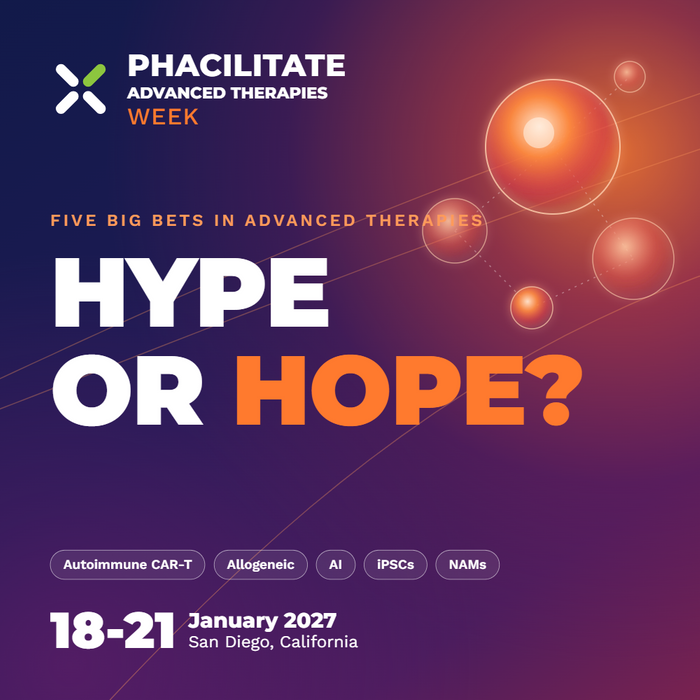
Five Big Bets in Advanced Therapies: Hype or Hope?
Five technologies are reshaping how advanced therapies are developed, manufactured and delivered: autoimmune CAR-T, AI, off-the-shelf cell therapies, iPSCs and non-animal testing. Breakthroughs are being announced, regulation is evolving, and tools once limited to the lab are edging towards clinical and commercial use.
Big questions remain, though. Will early results deliver lasting patient benefit? Can manufacturing scale while staying affordable? And can these technologies prove real value beyond the buzz?
Heading into 2027, some have already hit major milestones, while others face hurdles that will decide whether they become essential tools or costly experiments. The question is which deserve the hype, and which offer genuine hope.
1. Autoimmune CAR-T: Breakthrough or biotech's next hype cycle?
Could CAR-T reshape the future of autoimmune disease treatment, moving beyond chronic immunosuppression toward a more targeted, potentially durable immune reset?
Early clinical progress has generated significant excitement, but important questions remain around long-term outcomes, safety, scalability and commercial viability. So, is autoimmune CAR-T a genuine breakthrough, or is the industry getting ahead of the evidence?
The case for hope
In July 2026, researchers led by Lingling Shan and colleagues, with affiliations including Hangzhou Normal University, published a phase 1/2 study in Molecular Therapy evaluating CAR-T therapy in 18 patients with systemic lupus erythematosus (SLE).
The study reported clinical responses in 12 of 15 patients with active disease at six months, with most responders remaining off immunosuppressive treatment during follow-up. These early findings reinforce the potential for CAR-T to deliver a more durable approach to autoimmune disease management.
The case for caution
Safety concerns have brought renewed scrutiny. In August 2026, Novartis and Bristol Myers Squibb paused autoimmune CAR-T clinical programs following serious adverse events.
An October 2026 Nature Medicine analysis explored the implications, particularly the higher safety bar required when treating chronic autoimmune conditions. Questions around long-term durability, scalability and commercial viability also remain unresolved.
The big question for 2027: Is autoimmune CAR-T a genuine breakthrough, or is the industry getting ahead of the evidence?
At Phacilitate Advanced Therapies Week 2027, we'll explore what it will take for cell and gene therapies to compete in autoimmune disease, from meeting a higher safety bar and achieving durable immune reset to demonstrating meaningful value against established, lower-cost treatment options.
The agenda includes a fireside chat on autoimmune CGT development and safety, alongside a panel examining where these therapies can realistically compete.
Samik Basu, Chief Scientific Officer at Cabaletta Bio and chair of our autoimmune disease session, shares his perspective:
“CAR T cell therapy in autoimmune diseases has generated excitement because of its potential to reshape how we think about treating these conditions. The progress to date has reinforced the opportunity ahead, particularly with autologous approaches, while questions around long-term outcomes, safety, and scalability will need to be considered as the evidence base grows. I look forward to chairing this dialogue and sharing my perspective on how Cabaletta and our industry can advance CAR T cell therapy innovation closer to patients.”
2. Allogeneic cell therapy: Is off-the-shelf finally coming of age?
Autologous cell therapy has demonstrated the clinical potential of personalized medicines. It has also exposed the difficulties involved in manufacturing a treatment individually for each patient.
Allogeneic therapies offer a different model. By developing treatments from donor-derived cells, manufacturers could potentially produce multiple doses from a common starting material, creating opportunities for faster availability, more standardized production and improved economies of scale.
But does the clinical evidence support the commercial ambition?
The case for hope
In July 2026, Dr. Samer A. Srour of The University of Texas MD Anderson Cancer Center, alongside Allogene Therapeutics and collaborating investigators, published results from the phase 1 TRAVERSE trial in the Journal of Clinical Oncology.
Evaluating the allogeneic CAR-T therapy ALLO-316 in 51 patients with advanced renal cell carcinoma, the study reported a 17.4% overall response rate, rising to 31.3% in a biomarker-defined subgroup, providing early proof of concept for off-the-shelf CAR-T in solid tumors.
The case for caution
Clinical activity does not automatically translate into commercial viability. The TRAVERSE trial also reported significant hematologic toxicity, including severe neutropenia in 62% of patients.
As highlighted in the published trial findings, immune rejection, cell persistence, safety and manufacturing complexity remain important considerations. The economic advantage of allogeneic therapies has yet to be established at scale.
The big question for 2027: Can allogeneic therapies deliver comparable clinical performance while realizing the speed, scalability and cost advantages of off-the-shelf manufacturing?
The future of allogeneic cell therapy has a dedicated focus in the 2027 agenda, exploring the scientific advances and commercial decisions that will determine its role over the coming years.
Discussions include Reimagining allogeneic cell therapy: What success will look like in 2030, Engineering the allogeneic edge: Safety, efficacy & scalability breakthroughs, and Winning the allogeneic race: Commercial viability in a crowded modality landscape.
Together, these sessions will examine whether allogeneic approaches can deliver a genuine competitive advantage, not just in manufacturing, but in clinical outcomes, cost and patient access.
3. AI in advanced therapies: Transformative technology or expensive promise?
Artificial intelligence has become one of the most discussed technologies in biopharma. Its potential applications across advanced therapies are extensive.
From identifying therapeutic targets and optimizing experimental design to analyzing manufacturing data and predicting process deviations, AI promises to make complex development processes more efficient.
But the advanced therapies sector presents a particularly difficult environment for deploying these tools. Biological variability, limited datasets, complex manufacturing processes and stringent regulatory expectations create challenges that cannot be solved by algorithms alone.
The case for hope
In May 2026, AiCella presented research in Cytotherapy examining AI-driven manufacturing analytics using data from 128 CAR-T patient batches.
The research demonstrated the feasibility of using machine learning to identify parameters associated with patient response, highlighting potential applications in manufacturing optimization and quality monitoring. These were preliminary findings presented in a conference abstract.
The case for caution
AI models are only as reliable as the data behind them. A May 2026 study by Johnny Peng and colleagues, published in Chemical Engineering Journal, examined machine-learning approaches for cell-culture process monitoring.
The research highlighted challenges associated with limited datasets and transferring models between different manufacturing environments. For regulated advanced therapies, validation, reproducibility and measurable operational benefits remain essential.
The big question for 2027: Where is AI already delivering measurable improvements, and where is industry enthusiasm running ahead of the evidence?
AI's role in advanced therapy development and manufacturing will be explored through practical discussions focused on where the technology can deliver genuine value.
The agenda includes a dedicated AI Workshop, a roundtable on Responsible Use of AI in Manufacturing, and a session asking whether automation delivers meaningful benefits or simply introduces unnecessary cost and complexity.
Together, these discussions will challenge the industry to move beyond the promise of intelligent technologies and examine what successful implementation actually looks like, from data quality and validation to measurable operational improvements.
4. iPSCs: Has the promise finally become reality?
For years, induced pluripotent stem cells (iPSCs) have represented one of regenerative medicine's most ambitious possibilities. By reprogramming mature cells into a pluripotent state, researchers can generate cells capable of differentiating into many specialized cell types.
In principle, this creates opportunities to develop new therapies for diseases involving damaged or lost tissue.
In 2026, the field reached a landmark moment.
The case for hope
In March 2026, Japan granted conditional and time-limited marketing approvals to two iPSC-derived therapies.
Amchepry, developed by Sumitomo Pharma and Racthera from research led by Professor Jun Takahashi at Kyoto University, targets Parkinson's disease. RiHeart, developed by Cuorips from research led by Professor Yoshiki Sawa at the University of Osaka, targets ischemic cardiomyopathy.
The landmark decisions were covered in an April 2026 Nature Biotechnology article examining the world's first two conditionally approved iPSC therapies.
The case for caution
Conditional approval is not the same as established long-term effectiveness. Both therapies require further evidence to demonstrate sustained clinical benefits and safety.
As discussed in Nature Biotechnology's coverage, manufacturing consistency, tumorigenic risk, immune compatibility and scalability remain important barriers to wider adoption.
The big question for 2027: Will Japan's landmark approvals accelerate the emergence of scalable regenerative medicines, or reveal the difficulties of translating iPSC technology into routine clinical care?
Will Japan's landmark approvals accelerate the emergence of scalable regenerative medicines, or reveal the difficulties of translating iPSC technology into routine clinical care?
On the agenda at Phacilitate Advanced Therapies Week 2027
As iPSC-derived therapies move closer to clinical reality, the focus is shifting from scientific possibility to whether these treatments can be manufactured consistently, affordably and at scale.
At Phacilitate Advanced Therapies Week 2027, a dedicated session will explore Can the production of iPSC-derived beta islets for Type I diabetes be scaled up to be commercially viable?
The discussion brings the broader iPSC debate into sharp focus: how can manufacturers translate promising regenerative medicine platforms into reliable products that are economically sustainable and accessible to patients?
5. New Approach Methodologies: Can we move beyond animal testing?
Few areas of drug development illustrate the tension between scientific innovation and regulatory practice as clearly as New Approach Methodologies, or NAMs.
These approaches include human cell-based assays, organ-on-chip systems, computational models and other techniques that may reduce or replace animal testing in appropriate circumstances.
The scientific argument is compelling: methods that better reflect human biology could potentially improve the prediction of safety and efficacy.
But regulatory acceptance depends on demonstrating that these alternatives generate evidence suitable for the specific development decision.
The case for hope
In September 2026, the US Food and Drug Administration (FDA) announced regulatory changes recognizing the use of scientifically appropriate non-animal methods in preclinical safety testing.
The agency also introduced a database featuring 25 examples of New Approach Methodologies (NAMs) used in regulatory submissions, demonstrating growing acceptance of alternative testing strategies.
Read the FDA's September 2026 announcement.
The case for caution
Regulatory encouragement does not mean animal studies are disappearing. The FDA explicitly confirmed that its updated regulations do not change evidentiary standards or prohibit animal testing.
As the FDA's guidance explains, alternative methods must be adequately validated and appropriate for their intended use. For complex cell and gene therapies, demonstrating that NAMs can reliably assess long-term safety and systemic effects remains a significant challenge.
The big question for 2027: When can non-animal models genuinely replace animal studies, and what evidence will regulators require before accepting them?
The transition toward non-animal testing raises important questions about how developers build evidence and navigate evolving regulatory expectations.
At Phacilitate Advanced Therapies Week 2027, discussions across early clinical development and regulatory strategy will examine how emerging scientific approaches can support development while meeting the evidence standards required to progress therapies toward patients.
For developers, the challenge is translating regulatory ambition into practical strategies that regulators will accept, particularly when conventional animal studies may still be expected.
Five technologies. One defining challenge.
These developments may address different parts of the advanced therapies landscape, but they share a fundamental challenge. The industry must demonstrate that scientific possibility can translate into reliable, meaningful and accessible patient outcomes.
Autoimmune CAR-T needs to establish its long-term risk-benefit profile. Allogeneic therapies must prove that off-the-shelf manufacturing delivers a meaningful advantage. AI needs measurable evidence of impact. iPSC therapies must build on early regulatory milestones with convincing long-term results. And NAMs must move from regulatory encouragement to dependable implementation.
None can be judged by scientific potential alone. Their futures will depend on clinical evidence, manufacturing readiness, regulatory confidence, economic sustainability and ultimately, patient benefit.
These questions will be central to conversations at Phacilitate Advanced Therapies Week 2027, January 18–21 in San Diego.
Across discussions spanning early clinical development, manufacturing, commercialization, innovation and patient access, industry leaders will examine what is working, what remains uncertain and where the next breakthroughs may emerge.
The Oxford-style autoimmune CAR-T debate is one example, bringing competing considerations into focus as the industry weighs encouraging clinical results against renewed safety concerns.
Because the difference between hype and hope isn't how exciting a technology sounds. It's what the evidence can prove.
Tickets now available, with Super Early Bird rates ending October 31st, 2026. For more information on the agenda & tickets, visit www.phacilitate.com/advanced-therapies-week.
- Software
- CDMO / CMO Services
- COGs optimisation
- Cell-Based Immuno-Oncology (Cell Based-IO)
- Software & Digital Tools
- CRO Services
- Immunology
- Oncology
- Stem Cell
- Cell Therapy
- Cell product manufacturing
- Advanced Therapies Week
- Toxicology
-
Why Saudi. Why Now. Why the Global Advanced Therapies Community Should Pay Attention.
16 Jun 2026 Phacilitate -
[Whitepaper] The Science Is Proven. The Systems Are Not
02 Jun 2026 Elizabeth Figueroa PhD, Practice Expert, Dark Horse Consulting