The questions developers are now asking
Regulatory decisions used to sit late in the development plan. Today they shape it from day one. Developers are asking:
- Where should we run first-in-human studies?
- Which regulatory pathways offer the most predictability?
- How can evidence generated in one jurisdiction support approval in another?
- What happens when development, approval and reimbursement requirements don’t line up?
There are no universal answers, because the major markets are moving in different directions.
Three regions, three directions
United States: flexibility, with open questions
The FDA has been evolving its approach through incremental guidance, greater CMC flexibility and its plausible mechanism framework. That signals a willingness to adapt to the realities of CGT development.
But there is a tension. While regulators explore more flexibility, questions remain about emerging modalities, including in vivo therapies.
What it means for developers: how do you plan a development programme when regulatory expectations are still taking shape?
China: a changing clinical development opportunity
China is becoming a more attractive place to start development. Proposals for 30-day review of CGT clinical trial applications, the established role of investigator-initiated trials and the country’s growing appeal as a development market are all drawing attention.
What it means for developers: could the geography of early clinical development shift, and what would that mean for later global filings?
Europe: evidence and access move closer together
Joint clinical assessments for ATMPs are raising the importance of thinking about clinical evidence requirements alongside future market access, not after it.
What it means for developers: evidence plans built for approval alone may not be enough.
Where the map gets complicated
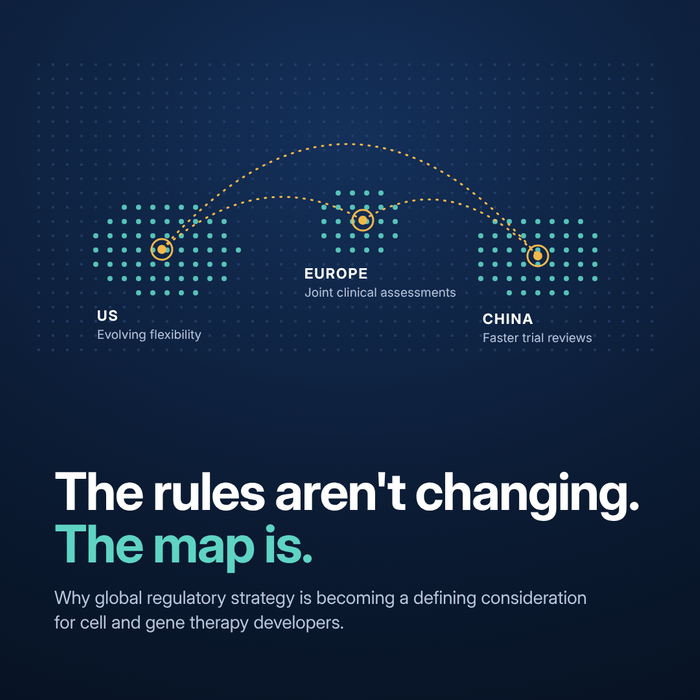
Put together, the picture looks like this: the US may offer evolving flexibility, China may open new early-development opportunities, and Europe may add evidence considerations.
The risk is that a decision made to accelerate progress in one market creates complications in another.
The review process is changing too
Innovation isn’t limited to the therapies. The way they are evaluated is evolving as well. Two areas stand out.
AI in regulatory review. The FDA is using AI, including Elsa 4.0, in its work. How might that influence review processes? And what does it mean for submission quality, transparency and how developers interact with regulators?
Emerging modalities. Some technologies don’t fit neatly into established development and assessment frameworks, particularly in vivo therapies and individualised medicines. How regulators approach them will shape the next wave of programmes.
Harmonisation remains the ambition. What happens in the meantime?
Regulatory systems are evolving at different speeds and in different directions. Full harmonisation is the long-term goal, but developers can’t wait for it.
Meaningful alignment would look like:
- Greater consistency in evidence expectations across regions
- Earlier dialogue between developers and regulators
- More international regulatory collaboration and reliance
- Development strategies that anticipate requirements across multiple markets from the outset
The practical question for now: if harmonisation is still some way off, how do you build a global strategy around the differences that exist today?
What it means across the sector
Biotech. Where you choose to begin clinical development could influence your entire global regulatory pathway.
Pharma. As regulatory systems evolve differently, global filing and launch strategies will need to adapt.
Investors. Regulatory uncertainty is becoming a bigger factor in assessing development timelines, geographic risk and asset value.
CDMOs. Diverging expectations across markets are adding complexity to global manufacturing and CMC strategies.
Bringing the regulatory conversation to ATW27
Advanced Therapies Week 2027 is where the industry can put these questions directly to regulators and fellow developers.
Regulator drop-in. Direct engagement with regulatory representatives on the practical challenges facing CGT developers.
Day 2 regulatory roundtable. A broader discussion on how regulatory priorities are evolving and what greater international alignment could mean for the sector. Speakers include:
- Steven S. Oh, Director, Office of Cellular Therapy and Human Tissue, Office of Therapeutic Products, CBER, US FDA
- Yoshiaki Maruyama, Director, Office of Cellular and Tissue-based Products, Pharmaceuticals and Medical Devices Agency (PMDA), Japan
The rules aren’t changing. The map is. Come and work out how to navigate it.
View the ATW agenda for the full regulatory program